On a Tuesday morning at John Glenn Columbus International Airport, a robotic arm reaches into a refrigerator, pulls out a ball of raw dough, rolls it out, layers on sauce, cheese, and pepperoni, and slides the pizza into an oven — all without a single human hand involved. Six minutes later, a traveler picks up a hot, freshly made Donatos pie from a locker. The Columbus-headquartered company’s kiosk does it all with no cashier and no kitchen staff. Just a machine, a QR code and lunch.
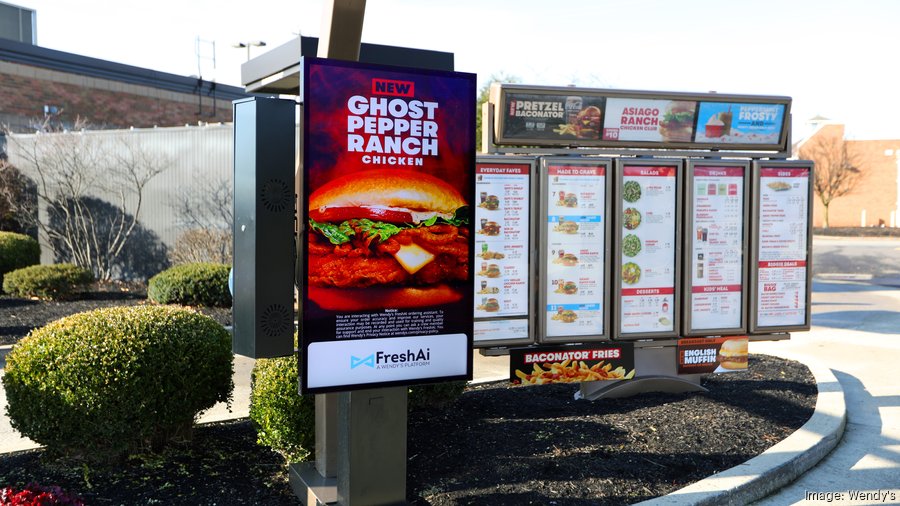
A few miles away in the suburb of Dublin, engineers at Wendy’s headquarters are reviewing performance data from AI-powered drive-thrus that have been using generative artificial intelligence to take customer orders, handling everything from a simple cheeseburger to a Dave’s Double with light mayo and extra pickles, and shaving an average of 22 seconds off service times at test locations.
And at a White Castle prototype dubbed the “Castle of Tomorrow,” is situated not far from the company HQ. There, an AI voice assistant named Julia takes drive-thru orders while a robotic fry station handles the Chicken Rings.
All of this is happening right here in Columbus, arguably the most important test kitchen for the future of fast food in America.
These AI and automation innovations are the fast food industry’s most current evolutions, Columbus has been the industry’s top restaurant laboratory for over 40 years. A 1985 New York Times feature identified the city as a preferred proving ground for chains looking to read America’s appetite before committing to a national rollout. Over the years, other national media outlets reported on it too: CBS News in 2012, and The New York Times came to town again in 2017. Four decades after that first recognition, the story still holds true and is stronger than ever.
John Barker, president and CEO of the Ohio Restaurant & Hospitality Alliance and a former Wendy’s vice president, told Axios Columbus that the city is a “dream market.” The same Axios story on the city’s test market history, captured why: Columbus offers “a wide snapshot of America in one region.” Urban, suburban, and rural communities sit within a short drive of each other. The population is diverse — young professionals, college students, families, immigrants from around the world — and it just keeps growing.
The most current census numbers illustrate this. Columbus’s metro growth rate of 1.0 percent is exactly double the national average of 0.5 percent. Among the 55 largest U.S. metros, Columbus ranks 15th for percentage growth — the only Midwestern market in that tier outside the Sun Belt. The city added nearly as many net new residents as Chicago last year, despite being a fraction of Chicago’s size. And Columbus ranks ninth nationally for concentration of adults aged 25 to 34, the most coveted consumer demographic, and is the only Midwest metro in the top ten — putting it in rare company with Austin, Denver and Nashville.
“Columbus mirrors national growth trends while outperforming them,” says Irene Alvarez, chief marketing and communications officer for the Columbus Partnership. “For brands looking for a market that’s representative without being oversaturated, and ambitious without being unpredictable, Columbus remains one of the most reliable proving grounds in the country.”
The innovations emerging from Columbus right now represent distinct approaches to the same underlying challenge: How do you run a restaurant with less labor, more consistency and longer hours without sacrificing the experience that built the brand?
Wendy’s answered with FreshAI, a generative AI drive-thru ordering system that uses large language models trained on Wendy’s entire menu, capable of handling complex customizations and natural, informal conversation. With hundreds of ways to order a Dave’s Double alone, the company recognized that generative AI, rather than a scripted system, can handle the real-world variability of a drive-thru line. At its best-performing Columbus test location, the system achieved 86 percent fully autonomous order accuracy, with service times 22 seconds faster than the market average. Wendy’s has since expanded FreshAI to multiple Columbus locations, opened the pilot to franchisees nationally, and added Spanish-language capability.
Donatos took a more radical leap: no humans in the kitchen at all. Its fully autonomous restaurant at John Glenn Airport opened in June 2025. Robotic arms assemble made-to-order pizzas in roughly six minutes, with the unit capable of producing up to 26 pies per hour, operating 24 hours a day, seven days a week. “It’s not a pre-made pizza — you can watch robots making your pizza,” CEO Kevin King said. The airport environment, where travelers prioritize speed over ambiance, is an ideal first location. Donatos plans to expand the model to hospitals, casinos, and office buildings — anywhere a traditional kitchen footprint is impractical but hunger is reliable.
White Castle went widest. Its Crave & Go kiosk program, is deploying hot-food automated units in 1,000 nontraditional locations, such as hospitals, college campuses, and corporate offices, with a goal of 5,000 total machines. The kiosks prepare sliders on demand, around the clock. With 72 percent of its locations already open 24/7, White Castle is essentially “bottling” its late-night identity into a machine that can go wherever demand exists, without the overhead of a full restaurant.
What the Columbus experiments are already proving is that the upside for customers is real: faster service, fewer wrong orders, hot food available at 2 a.m. in an airport or a hospital lobby, all conveniences that a fully staffed kitchen can’t always deliver. What other benefits they’ll reveal is still being discovered, one robot-made pizza and one AI-handled drive-thru order at a time.
Columbus has always had an appetite for what’s next. Turns out, so does the rest of America — it just needed somewhere to taste it first.